BBVA channeled €27 billion into the sustainable business of its emerging markets in 2024.This includes financing social, educational and health infrastructure, as well as projects related to climate change.
These funds also include support for entrepreneurs and startups, and the financial inclusion of disadvantaged groups.
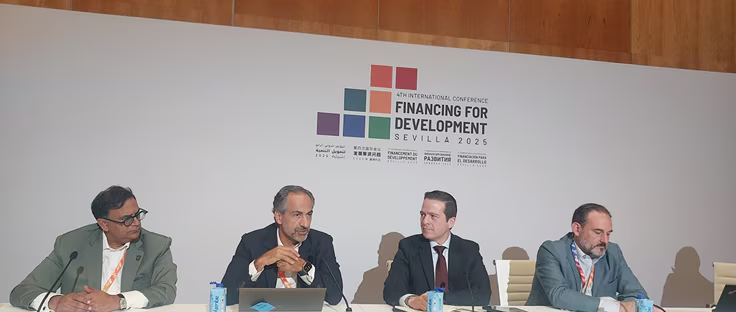
BBVA is providing these figures in the framework of the 4th International Conference on Financing for Development (FFD4), organized by the United Nations (UN) in Seville, June 30 – July 3.
Experts from BBVA and the BBVA Microfinance Foundation participated in the event where they stressed the need to promote the energy transition in emerging economies and boost development funding.
In one of the sessions organized by the World Economic Forum, Iván Poza, Head of the Public Sector at BBVA, advocated for implementing formulas to scale up private investment in climate solutions in countries with the greatest needs in their energy transition.
Poza underscored “the key role banks play in channeling resources to adaptation and mitigation projects, and the need to create stable regulatory frameworks that blend public and private capital.”
Meanwhile, the Global Head of Sustainability Intelligence at BBVA, Antoni Ballabriga, argued for “moving toward a more inclusive financial architecture that takes into account the asymmetries between developed and developing countries.”
“It is essential for the financial industry to integrate principles of equity and social cohesion into product and strategy design. BBVA is working on internal standards related to social issues, and the development of personalized solutions for different groups of the population,” he said.
He also stressed that “the systemic transformation to mobilize private capital at the scale we need represents a great opportunity, and it will only take place if it makes sense from a financial standpoint.”
“Unblocking large-scale blended financing is vital. For every dollar of multilateral investment today, only €0.50 of private capital is mobilized. It is essential for multilateral banks to prioritize not just the sustainable finance they provide directly, but above all, the mobilization of private capital they enable through guarantees and large-scale first-loss mechanisms with streamlined processes.”